EN · FISHKEEPING
Stop Feeding Live Feeder Fish to Your Predator
Feeder goldfish look like the natural choice for an arowana or a gar. They carry parasites, destroy vitamin B1, and fatten the liver. Frozen food and pellets do the same job without the risk.
Published: November 20, 2026
Updated: November 20, 2026
7 min read
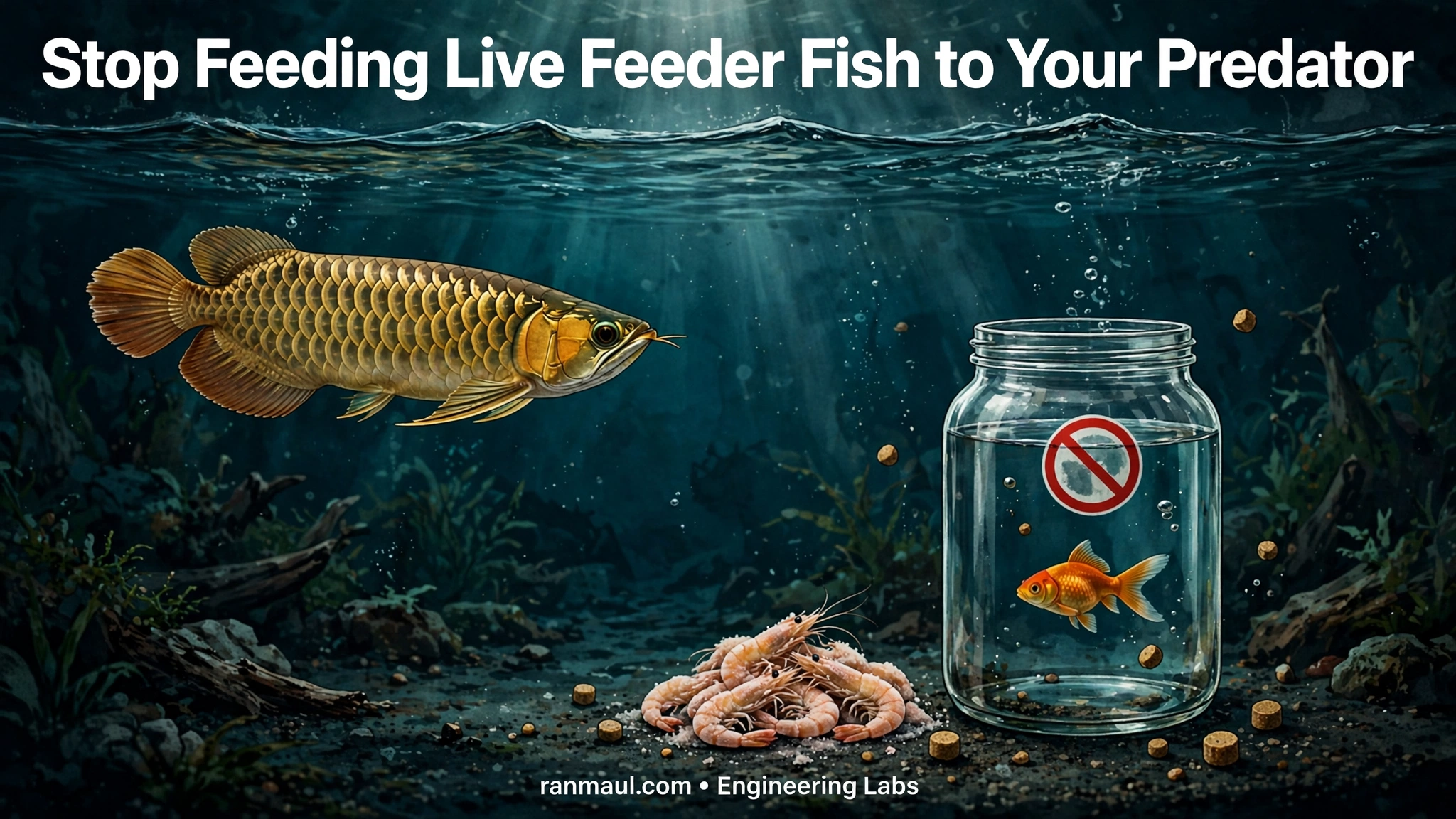
Your arowana eats the feeder goldfish in seconds. It looks natural. A predator eating a live fish is what the tank is for.
The problem is what comes with the goldfish. Feeder fish from a shop tank are raised crowded, underfed, and barely filtered. Every one you drop in is a possible disease vector. Even a healthy feeder goldfish carries two problems no quarantine can fix: an enzyme that destroys vitamin B1, and a body full of saturated fat.
This article covers why feeder fish are a bad staple, what to feed instead, and how to convert a fish that only eats live food.
#The three problems with feeder fish
#1. Disease rides in with the food
Feeder fish live in overcrowded, poorly filtered shop systems. Parasites, gill flukes, internal worms, bacterial infections, and viral disease are endemic in those tanks. Your predator eats the feeder whole, parasites included.
This is the same vector the quarantine article warns about, except you are deliberately adding it to the display tank. A 30-day quarantine protects a new fish. Feeding live feeders every week undoes that protection on a schedule.
#2. Thiaminase destroys vitamin B1
Goldfish and other cyprinids contain thiaminase, an enzyme that destroys thiamine (vitamin B1). A predator fed feeder goldfish regularly gets a steady dose of it.
B1 deficiency shows up as erratic swimming, loss of coordination, and seizures. Left uncorrected, it is fatal. This is documented in veterinary and aquaculture literature, not a hobby rumour.
#3. Fat and poor nutrition
Feeder goldfish are high in saturated fat. Regular feeding causes fatty liver disease (hepatic lipidosis), the leading cause of premature death in captive arowana. A mass-produced feeder raised on flake food in a crowded tank is also nutritionally poor by every measure: protein quality, vitamins, minerals, and fatty acids.
Three problems, one food. That is a bad staple.
#What to feed instead
The base is frozen food. It is nutritionally dense, and flash-freezing kills most parasites. Rotate 3 to 5 food types across the week. No single food covers everything.
- Raw shrimp, shell-on. The single best all-around food for most predators. Shells supply calcium. Buy market-grade raw shrimp, not pre-cooked. Remove the tail spike for smaller fish.
- Smelt and silversides. Whole small fish give complete nutrition: protein, fat, minerals, vitamins, and calcium from the bones. Feed them whole. Size-match them: 5 cm silversides for a 30 cm fish, 10 cm smelt for a 60 cm fish.
- Earthworms. Outstanding protein and amino acids. Buy pesticide-free nightcrawlers from a bait shop, or culture your own. Rinse before feeding.
- Frozen krill. Rich in astaxanthin, the pigment that deepens red and orange colour. Good for red and golden arowana.
- Mussel and clam meat. Trace minerals other foods lack. Feed once or twice a week.
Thaw frozen food in tank water before feeding. Never microwave it or use hot water. That denatures the protein. Feed it right after thawing and never refreeze it.
#Pellets are the insurance, not the meal
High-quality carnivore pellets fill the vitamin and mineral gaps that whole foods leave. Sources disagree on the share. One feeding guide puts pellets at 20 to 30 percent of the diet, while an arowana nutrition guide says a good pellet can be 60 to 70 percent of an adult arowana's diet. Treat the disagreement as a sign: pellets are a supplement to a varied frozen diet, not a replacement for it.
Two products fit this tank well. Hikari Massivore is a large sinking pellet at 45 percent protein or more, with garlic as an appetite stimulant and vitamins C and E. Hikari Carnisticks are floating sticks for surface feeders like arowana and gar. They soften slowly, which lowers the risk of bloat from a pellet expanding in the stomach.
Check the label before you buy. Whole fish meal, shrimp meal, or insect protein should sit near the top. Wheat flour and soy fillers add bulk and cloud the water as undigested material breaks down.
#How often, and how much
Frequency falls as the fish grows:
- Juveniles under 15 cm: daily.
- Sub-adults, 15 to 30 cm: every other day.
- Adults over 30 cm: every 2 to 3 days.
Each meal should be gone in 2 to 3 minutes. After a meal, a visible food bulge is normal and should subside within 24 hours. If the belly is still distended after 48 hours, skip the next feeding and check for bloat.
Keep one fast day per week. Wild predators do not eat every day, and the fast gives the digestive system time to finish the last meal. Overfeeding is the default problem in a predator tank, not underfeeding. A healthy predator has a slightly convex belly: not sunken, not bulging.
#Converting a fish that only eats live food
Arowanas raised on live food are the stubborn case. The conversion takes patience, not force.
Mix pellets with a food the fish already accepts, usually shrimp. Then reduce the shrimp share and raise the pellet share over 2 to 3 weeks. Some fish hold out and need a fast of 5 to 7 days before hunger wins. Offer the pellet at the usual feeding time, at the surface, and remove what is not eaten.
A healthy adult arowana can fast for days without harm. If the fish still refuses after a week, test the water first. Poor water quality is the most common reason a predator stops eating, and a fish that will not eat pellets may be telling you something else is wrong.
#Live food, done right
Live food still has a place. It triggers hunting behaviour and gives enrichment that frozen food cannot. Keep it as a treat, not the staple.
- Gut-loaded crickets. Feed the crickets fish flake and vegetables for 24 hours first. The gut contents become part of the nutrition. Good for surface feeders.
- Ghost shrimp. Low disease risk compared with feeder fish. Gut-load them with spirulina flake.
- Blackworms. Clean, nutritious, and accepted by almost all predators.
- Dubia roaches. High protein, low fat, easy to culture. Remove the wings first.
Feed mealworms sparingly. Their chitin can cause intestinal impaction in fish that do not naturally eat hard-shelled prey. Never feed wild-caught insects or centipedes. Pesticide risk is not worth it.
#If you still insist on feeder fish
Quarantine them for 2 to 4 weeks in a separate system. Treat prophylactically for parasites with praziquantel and metronidazole. Feed them well during quarantine so they are worth eating.
Then ask whether the work is worth it. A month of quarantine, two medicines, and daily feeding of the feeders costs more than a bag of frozen shrimp. The honest answer is usually no.
#The checklist
- Build the diet on frozen food: shrimp, smelt, earthworms, krill, mussels. Rotate 3 to 5 types.
- Add a quality pellet for vitamins and minerals. Check the label for whole fish protein at the top.
- Feed juveniles daily, sub-adults every other day, adults every 2 to 3 days. Keep one fast day a week.
- Offer live food as enrichment: gut-loaded crickets, ghost shrimp, blackworms. Not feeder fish.
- Convert a live-food-only fish slowly: mix pellets with shrimp, shift the ratio over 2 to 3 weeks.
- If a fish refuses food, test the water before changing the menu.
#The bottom line
Feeder fish feel like the natural diet. They are the convenient one. The natural diet of a wild arowana is insects, crustaceans, and whole fish caught in clean water, not a goldfish raised in a crowded shop tank.
Frozen shrimp, whole smelt, and a good pellet give your predator the same hunt without the parasites, the thiaminase, and the fat. Your fish lives longer on the boring diet. Feed it that.
#References
- The Fish Collection, Predatory Fish Feeding Guide — the feeder fish problems, the frozen rotation, pellet brands, and the feeding schedule.
- Furry Critter Network, Arowana Food & Nutrition Products — pellet share for adult arowana, label checks, and the live-to-pellet conversion.
- Jaljeev, What Do Arowanas Eat? Food Choices and Feeding Cautions — the Merck Veterinary Manual warning on live food, and the pellet myths it corrects.
- FishyHub, Cara Jaga Ikan Arowana — varied diet over live fish, and feeding frequency by size.
- Quarantine the New Fish First: 30 Days That Protect Your Whole Predator Tank — the same disease logic, applied to new fish.
- Your Arowana Stopped Eating. Diagnose It in the Right Order. — water first, then stress, food, illness.