EN · FISHKEEPING
Your Arowana's Eyes Are Dropping. What Causes Drop Eye, and What You Can Still Do About It
Drop eye has no single proven cause, and once it sets in it rarely reverses. The honest picture is four theories, a short prevention list that actually lowers the risk, and a clear line between drop eye and the eye problems that do need treatment.
Published: November 14, 2026
Updated: November 14, 2026
8 min read
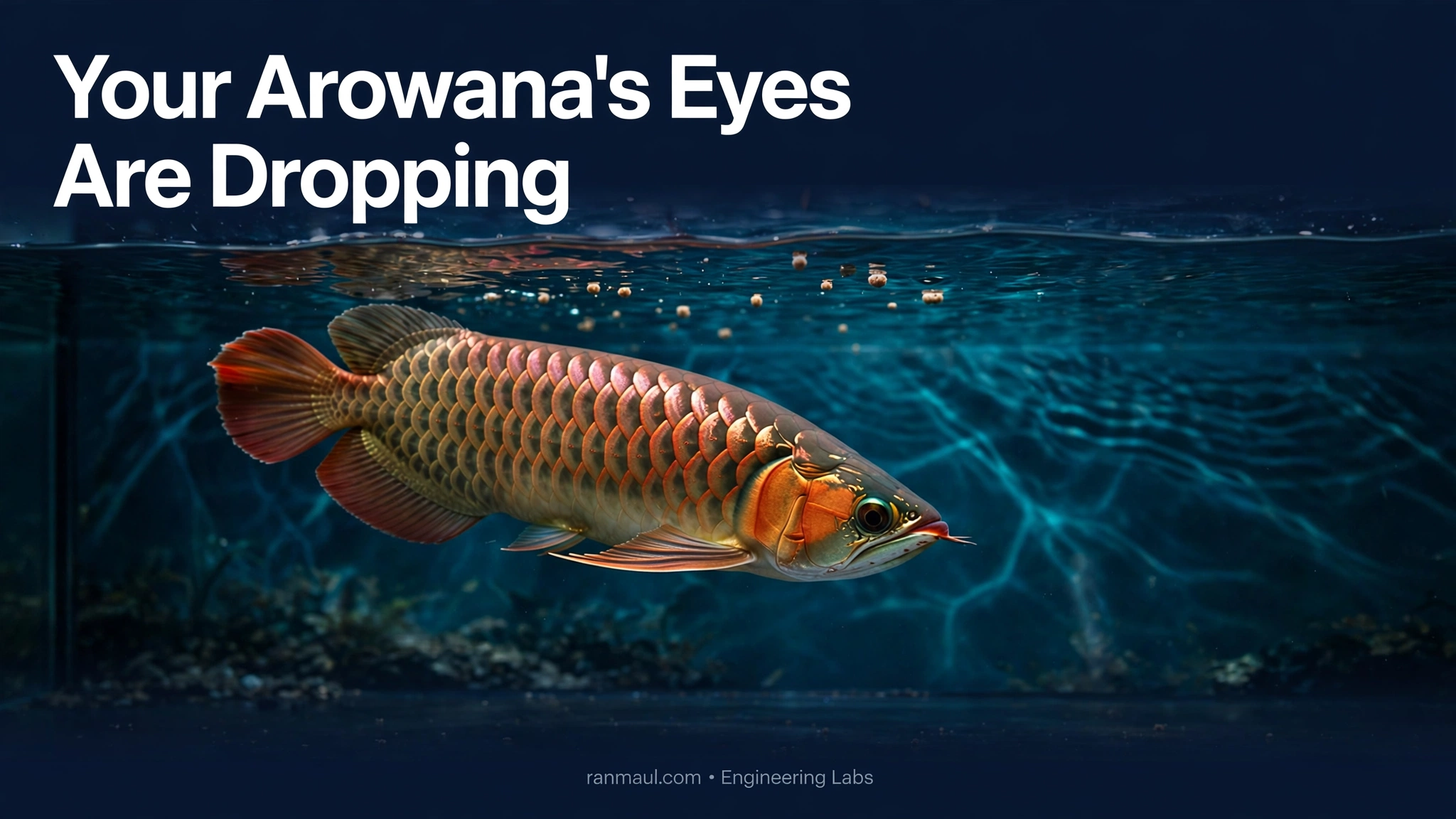
One morning you look at your arowana from the front and something is off. One eye points down at the floor instead of level with the other. The fish eats, swims, and behaves normally. Nothing else is wrong. But the eye stays down, and over the following months it drops further.
That is drop eye. It is the most talked-about arowana problem that is not a disease, and the most misunderstood. This article gives you the honest version: what it is, what probably causes it, what lowers the risk, and what to do once it appears.
#What drop eye is, and what it is not
Drop eye is one or both eyes pointing permanently downward, so the fish looks at the tank floor instead of straight ahead. It develops slowly, over months. The white of the eye shows more at the top. The fish otherwise eats, swims, and behaves normally.
It is not an infection. It is not a parasite. It is a structural change, linked to environment, diet, and genetics. That distinction matters, because it decides the treatment: there is no medicine for drop eye, and dosing one will not help.
It is also not cloudy eye. Cloudy eye is a white film over the eye, usually from bad water or an injury, and it can be treated. If the eye is cloudy rather than drooping, read the cloudy eye guide instead. The two problems look different, and they need different responses.
Drop eye does not usually hurt the fish. It eats and lives normally. What it hurts is show value: a fish with a dropped eye scores lower and sells for less. That is why keepers care so much about preventing it.
#The honest part: nobody knows the single cause
There is no single proven cause of drop eye. Experienced keepers and breeders disagree, and most believe it is a mix of factors. Four theories come up again and again.
Looking down. Arowanas are surface hunters. If food, tank mates, or movement are mostly below the fish, the eye muscles adapt to looking down. Sinking food, bottom-dwelling tank mates, and a busy floor below the tank all pull the gaze down.
Fat behind the eye. A rich diet, especially lots of feeder fish, builds fat behind the eye that pushes it down. This is why overfed arowanas on a feeder-fish diet show up so often in drop eye discussions.
A tank that is too shallow. In a shallow tank the fish spends more time near the bottom and looking down. Depth gives the fish room to swim level and look ahead.
Genetics and age. Some bloodlines seem more prone than others, and the risk rises as the fish gets older. Silver arowanas are affected more often than some other types, and keepers report that nearly all captive silver arowanas develop some degree of droop over time.
One more theory — reflection from a bare, shiny bottom — is disputed. Some keepers use a dark bottom or a thin layer of sand to remove the reflection. Others see no difference. Treat it as unproven, not as a fix.
#What actually lowers the risk
Prevention is the whole game with drop eye. Once it is established, it rarely reverses. Everything below is about keeping the fish looking up and lean while it is still young.
Feed at the surface. Use floating pellets as the staple and foods that stay at the top. Avoid foods that sink to the floor. Hand-feed prawn instead of letting it drop. Every meal is a training session for where the eyes point.
Keep the bottom quiet. Bottom-dwelling tank mates, moving décor, and a bright floor pull the gaze down. Keep the lower half of the tank simple and dark. If the bottom is boring, the fish has no reason to look at it.
Give the tank height. A tank of 60 cm height or more gives room to swim level. Adults need a long tank too, at least 5 to 6 feet. Height and length are both part of the prevention.
Feed lean and varied. Use quality pellets as a base, with insects such as crickets and superworms, prawn, and occasional fish. Do not rely on feeder fish. Fat arowanas are not healthy arowanas, and a fatty diet is the one risk factor you fully control.
Do not overfeed. An adult arowana does not need a full belly every day. Overfeeding builds the fat behind the eye and fouls the water at the same time.
Place the tank thoughtfully. Avoid a spot where people and pets move mainly below the tank, such as a low cabinet near a busy floor. The fish watches what moves, and it will watch downward all day if that is where the action is.
#Can drop eye be fixed?
Mostly, no. Once the eye has dropped and stayed down for months, it is usually permanent. The fish can still live a full, healthy life with mild drop eye if the water stays clean. That is the first thing to accept, because it stops you from chasing cures that do not exist.
Early cases are the exception. Some keepers report improvement when the drop is recent and slight, using methods that force the fish to look up: a floating object such as a ping-pong ball, or food offered only at the surface. Results are anecdotal, and nobody has measured them properly. Vitamin E supplementation gets mentioned the same way, also without solid evidence.
One older keeper remedy is more structured: cover all sides of the tank with dark paper up to the top, put a single central light above, and feed only floating food for about three months. The idea is to remove everything below the fish's line of sight. It is a long commitment, and the evidence is still keeper reports, not a study.
Specialist surgery exists. A vet can remove fat from behind the eye. It is expensive, it carries real risk, and it should only be considered for a valuable fish after talking to a fish vet or an experienced arowana specialist. Do not let anyone operate on your fish as a first resort.
What you should not do is dose medicine. Antibiotics and antiparasitics do nothing for a structural problem. They stress the fish and the filter, and they cost you money for no benefit.
#Check the eyes before you buy
Drop eye is easier to avoid at the shop than to fix at home. Check both eyes are level in photos and videos before you buy. Ask the seller about the line, the age, and the diet. A fish that was raised on sinking food in a shallow tank already carries the risk with it.
This applies to silver arowanas most of all. They are the most prone, and the most likely to have been kept in tanks that are too small for them. A cheap silver with one eye already low is not a bargain. It is a fish that will need the full prevention list from day one.
#The checklist
- Look at the eyes from the front, once a week. Early means slight, and slight is the only stage with a chance of improving.
- Feed floating food only. Pellets as the staple, prawn and insects for variety, hand-fed at the surface.
- Cut feeder fish out of the routine. They are fatty, and they teach the fish to hunt below.
- Keep the bottom simple and dark. No bright floor, no busy bottom tank mates.
- Check the tank height. 60 cm or more, and 5 to 6 feet long for an adult.
- Do not overfeed. A lean arowana keeps its eyes level longer.
- Do not dose medicine for a dropped eye. It is not an infection.
- If the drop is recent and slight, try the look-up routine. Floating object, surface feeding only, dark tank sides for a few months.
- Talk to a fish vet before any surgery. It is a last resort, not a first step.
#Conclusion
Drop eye is a prevention problem, not a treatment problem. No single cause is proven, but the four theories point in the same direction: keep the fish looking up, keep it lean, and give it a tall tank. Do that from the start and you have done everything the evidence supports.
If the eye has already dropped, be honest with yourself. The fish is not sick, and it is probably not going to improve much. Keep the water clean, keep feeding at the surface, and enjoy a healthy fish that looks down a little. That is a better outcome than a medicine cabinet full of bottles that never had a chance.
#References
- FishyHub, "Arowana Drop Eye & Hole in Head: Causes and Prevention for Malaysian Keepers" — the main theories, the prevention list, and the honest note that no single cause is proven.
- MonsterFishKeepers, "Arowana Disease and Cure" — the dark-paper and central-light remedy, and the fat-accumulation theory from long-time keepers.
- Aquamarine Power, "Silver Arowana Care Guide 2026" — early-stage exercise and vitamin E reports, and the note that nearly all captive silver arowanas develop some droop.
- Promeal, "Arowana Fish Health: Common Diseases and Their Treatments" — drop eye causes and the surgery-as-last-resort warning.
- How to Treat Cloudy Eye in Predator Fish — how to tell cloudy eye apart from drop eye.
- Your Arowana Stopped Eating. Diagnose It in the Right Order. — the diagnostic order this article's prevention list assumes.
- Water Parameter Management — the parameter targets to keep while a fish recovers.