EN · FISHKEEPING
Your Arowana Stopped Eating. Diagnose It in the Right Order.
An arowana that refuses food is usually telling you something in a specific order: water first, stress second, food third, illness last. Work the list in that order and you fix the cause instead of chasing symptoms.
Published: November 7, 2026
Updated: November 7, 2026
8 min read
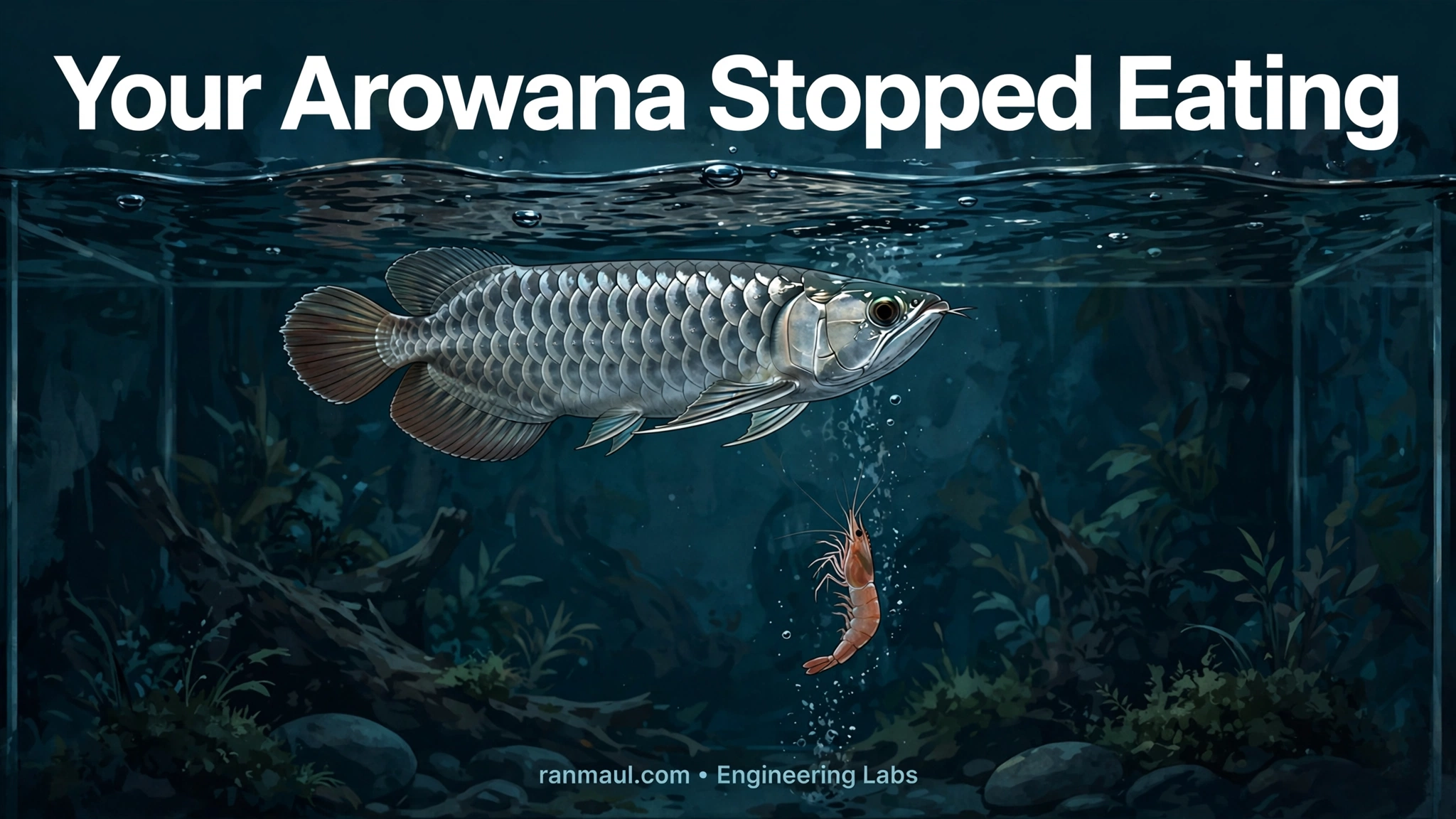
Your arowana ate yesterday. Today it circles the shrimp, looks at it, and swims away. Tomorrow it does the same thing. By day five you are reading forums at midnight, and by day seven you are ready to buy medicine.
Stop. An arowana that stops eating is not a mystery. It is a diagnostic problem, and it has an order. Most keepers work the list backwards: they change the food first, dose medicine second, and test the water last. That order wastes money and time, and it can turn a small problem into a sick fish.
The right order is: water, stress, food, illness. Work it top to bottom. Do not skip a step because it looks fine.
#First, tell spitting apart from refusing
These are two different problems with two different causes.
A fish that takes food into its mouth and spits it out wants to eat. The food is wrong: too big, too hard, or a type it cannot handle. A pellet that is too large for the mouth gets chewed and dropped. Dried insects that never softened get the same treatment.
A fish that will not approach the food at all has a different problem. It is stressed, sick, or sitting in water it does not like. Changing the menu does nothing for this fish.
Watch one feeding before you change anything. Does it approach and reject, or does it ignore the food entirely? The answer decides which half of this article applies to you.
#Step 1: test the water before you touch anything else
Poor water quality is the most common reason a predator stops eating, and it is the easiest to rule out. Ammonia and nitrite must read zero. Nitrate should stay under 20 ppm for an arowana. Temperature for most Asian arowanas sits between 24 and 30°C, and stability matters more than the exact number.
Test, do not guess. A liquid test kit gives you numbers. "The water looks clear" gives you nothing. Clear water can carry ammonia, and an arowana can smell it long before you can see anything wrong.
If ammonia or nitrite shows up at any level, do a partial water change of 25 to 50 percent, depending on how bad the reading is. Check that your tap water is dechlorinated first. Chloramine in tap water can spike ammonia after a water change, which is exactly the trap covered in the companion piece on the chloramine problem.
Also check the heater. A heater that failed overnight can drop the tank several degrees, and a cold arowana stops eating. A thermometer on the glass costs almost nothing and settles the question in one glance.
If the numbers are clean and the temperature is stable, move on. The water is not the problem, and no amount of extra water changes will fix what comes next.
#Step 2: ask what changed in the last two weeks
Arowanas are creatures of habit, and they punish change. A new tank mate, a rearranged piece of driftwood, a move to a bigger tank, a loud party next to the glass: any of these can put a fish off food for days.
The classic case is a scare. An arowana that jumps or slams into the lid or glass can go off food for a week or more. Keepers on the forums describe the same pattern: the fish swims, but not normally, and the back end sinks slightly when it stops. The fish is not dying. It is stressed and sore, and time plus clean water is the treatment.
Check for these stressors:
- New tank mates. Anything that chases, nips, or crowds the arowana at feeding time. Even a fish that only bothers it occasionally is enough.
- A recent move or rescape. Transport and new surroundings cost an arowana several days of appetite. This is normal.
- Reflection and light. A new light, a brighter room, or a bare glass side the fish can see its own reflection in. Arowanas will posture at a reflection for hours and skip meals while doing it.
- Removed tank mates. Keepers report arowanas going off food after a long-time tank mate leaves. The fish notices the change even when you think it should not.
If you find a recent change, fix the change or wait it out. Dim the lights, keep traffic past the tank low, and feed at the same time each day. Offer a small portion of the usual food, then remove whatever is uneaten after ten minutes. Uneaten food rots, and rotting food makes the water worse.
#Step 3: fix the food, not the fish
Only now, with water and stress ruled out, is the food worth changing. Arowanas are picky, and they learn habits fast. A fish raised on live food may refuse pellets for weeks. A fish fed the same shrimp every day for a year may simply get bored.
Three food problems cover almost every case:
- Too big or too hard. Cut shrimp and fish to a size the arowana can swallow in one or two bites. Soak dried food before offering it.
- One food only. Rotate between two or three staples: shrimp, fish fillet, insects such as crickets. Variety keeps the fish interested and covers more nutrition.
- Live-food addiction. A fish that only eats live feeders will hold out for them. Wean it by mixing: offer a pellet or a piece of shrimp first, while the fish is hungry, and only then offer the live food it wants. Hunger is a better teacher than patience.
One warning: do not keep throwing new foods at a fish that refuses. Five uneaten offerings in a day are five portions rotting on the bottom. Offer once, remove what is left, and try again tomorrow.
#Step 4: look for illness, and only now consider medicine
If the water is clean, nothing changed, and the food is right, look at the fish itself. Illness is the last step in the list, not the first, because medicine in a healthy tank causes more harm than a week of fasting.
Watch for these signs together with the refusal:
- White, stringy waste or a swollen belly.
- Clamped fins, faded color, or lethargy.
- Rapid breathing or hanging at the surface.
- Visible spots, fungus, or damaged barbels.
One symptom alone is weak evidence. Two or more, plus a fish that has not eaten for over a week, is a real signal. At that point, a photo and a water test result taken to an aquatic vet or an experienced keeper will get you further than a random bottle from the shelf.
Never dose medicine because you are worried. Dose it because you have identified a problem and the treatment matches it.
#How long can an arowana fast?
This is the question every keeper asks on day three, and the answer is reassuring. A healthy adult arowana can fast for days, and experienced keepers report fasts of two to three weeks with no lasting harm. Juveniles have less reserve and need attention sooner, but even they tolerate a few days.
The clock that matters is not the calendar. It is the body. A fasting fish that stays active, keeps its color, and holds its weight is waiting something out. A fish that loses weight, sinks at the tail, or fades in color is a fish that needs help.
Weigh the fish with your eyes. Look at it from above once a day. The body behind the head should stay full. When it starts to look pinched, the fast has gone on long enough.
#The checklist
- Test the water first. Ammonia and nitrite at zero, nitrate under 20 ppm, temperature stable at 24 to 30°C.
- Do a water change if any number is off. 25 to 50 percent, with dechlorinated tap water.
- Check the heater and thermometer. A cold tank stops feeding before anything else shows.
- List what changed in the last two weeks. New tank mates, a move, a rescape, a scare.
- Watch one feeding. Spitting means wrong food. Ignoring means stress, water, or illness.
- Offer small portions of the usual food. Remove uneaten food after ten minutes.
- Rotate two or three foods. Do not throw five new foods at the fish in one day.
- Look for illness signs only after the first three steps. White waste, swollen belly, clamped fins, lethargy.
- Do not dose medicine out of worry. Identify the problem first.
- Judge the fast by the body, not the calendar. Active and full-bodied means waiting. Pinched and faded means act.
#Conclusion
An arowana that stops eating is usually running a checklist of its own: the water is off, something changed, the food is wrong, or it is sick. Work the list in that order. Most keepers who do find the problem in step one or two, and the fish eats again within days, with no medicine bought and no food wasted.
The instinct to act fast is good. Aim it at the test kit, not the medicine cabinet.
#References
- Promeal, "What to Do When Your Arowana is Not Eating" — appetite loss causes: stress, water quality, illness, and diet.
- Promeal, "Fish Not Eating or Spitting Out Food? 7 Reasons" — spitting versus refusing, and the seven-way diagnostic table.
- MonsterFishKeepers, "Issue with arowana" — a real case: a spooked arowana that stopped eating, with keeper discussion of stress and recovery time.
- Broadheath Bettas, "Channa and Arowana Care" — temperature, filtration, and water-change baselines for arowana and channa.
- Your Water Change Just Spiked Ammonia: The Chloramine Trap — why tap water can spike ammonia after a water change.
- Water Parameter Management — the parameter targets this article's step one relies on.