EN · FISHKEEPING
Quarantine the New Fish First: 30 Days That Protect Your Whole Predator Tank
One new fish can wipe out an established predator tank. A bare quarantine tank, a cycled sponge filter, and 30 days of observation cost almost nothing — and they are the cheapest insurance in fishkeeping.
Published: November 16, 2026
Updated: November 16, 2026
7 min read
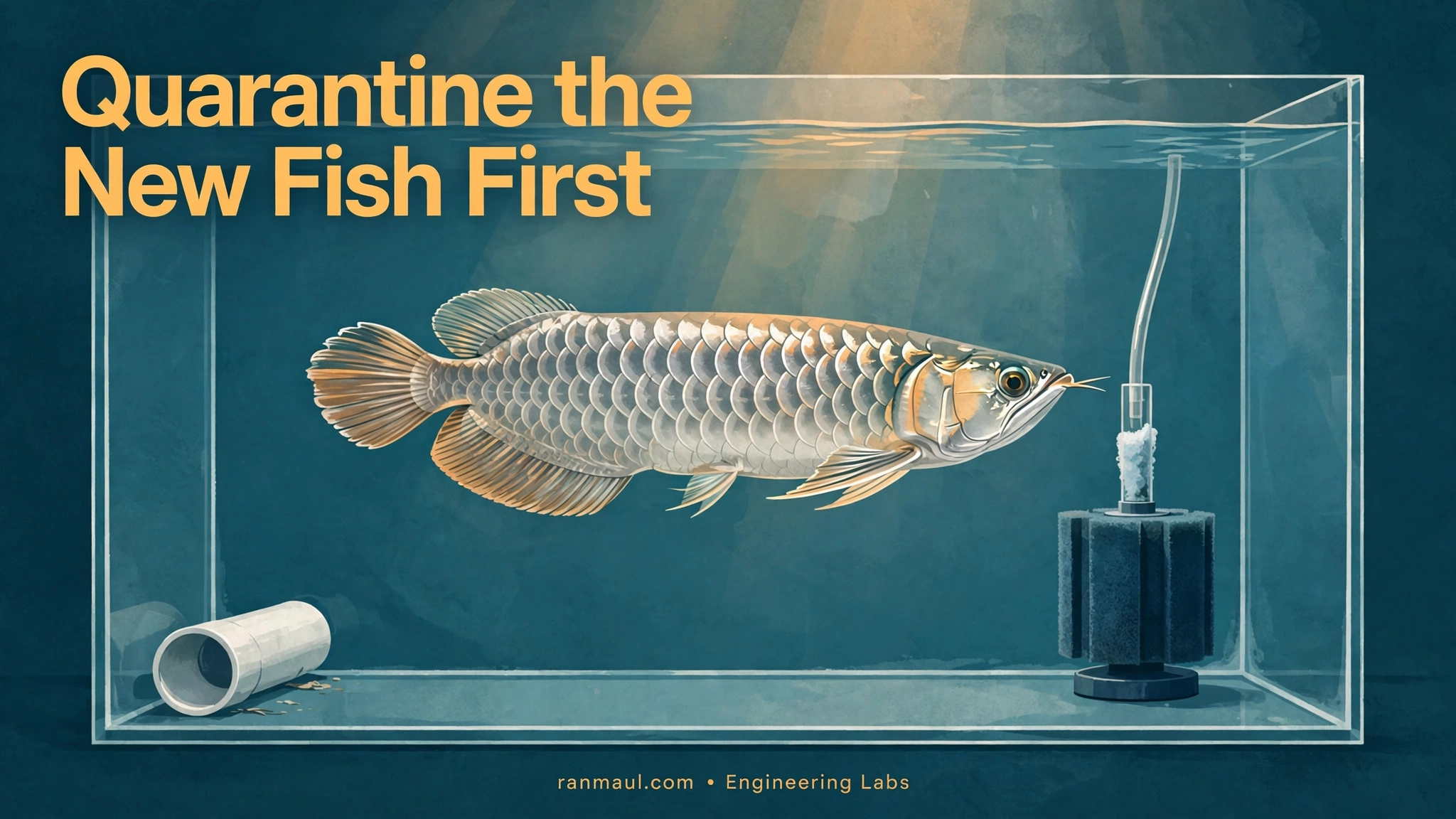
You bring home a new fish. It looks healthy, swims well, and eats at the shop. You float the bag, then release it straight into your display tank. A week later, white spots cover its fins. Two weeks later, your arowana stops eating and your channa hides in a corner. The whole tank is sick, and the new fish was the vector.
Quarantine is the habit that prevents this. It is boring, it takes a spare tank, and it tests your patience for a month. It is also the cheapest insurance in fishkeeping. This article covers the setup, the 30-day protocol, and the mistakes that undo it.
#Why one new fish can take down a whole tank
Shop fish pass through many hands before they reach you. Wholesalers, holding systems, and shop tanks each hold hundreds of fish from different origins. A fish can look healthy and still carry ich, velvet, internal parasites, or bacteria. Transport stress then triggers the outbreak in the days after you buy it.
Predator tanks amplify the loss. One arowana can be worth more than an entire community tank. Treating a display tank means medicating hundreds of litres, and most medicines stress the biofilter you spent months building. An outbreak in a predator tank is not a small problem with a small bill.
Quarantine is not paranoia. It is the one practice every serious keeper agrees on, and the one most often skipped because the fish "looks fine".
#The setup: a spare tank, not a second display
A quarantine tank does not need to be pretty. It needs to be clean, cycled, and easy to observe.
Keep it bare. No substrate, no rocks, no plants. A bare bottom makes waste and uneaten food visible, and cleaning takes minutes. You need to see what the fish produces. Substrate hides it.
Size it to the fish, not the room. A channa or a small predator is fine in 60 to 80 litres. A juvenile arowana needs 150 to 200 litres, or a large tub or stock tank. The tank is temporary. It only has to hold the fish safely for a month.
The cycled sponge filter is the key part. Keep a spare sponge filter running in your display tank or sump at all times. When you need the quarantine tank, move the sponge over. It carries an established bacterial colony that processes ammonia from day one.
A quarantine tank without a cycled filter is a second problem. Ammonia in quarantine kills faster than the disease you are trying to avoid. If you have no pre-cycled sponge, cycle the tank with bottled bacteria and an ammonia source for one to two weeks first. Test daily until ammonia and nitrite both read zero.
Add a heater, a thermometer, and a heavy lid. Predators jump, and a stressed new fish jumps more. One PVC pipe or a clay pot gives the fish a hide. Keep the light dim or off for the first day or two so the fish can settle.
Fill it with water from your display tank. That water is already dechlorinated and already at the right parameters. It is the safest starting point for a new arrival.
Keep separate equipment. A net, a bucket, and a siphon that belong only to the quarantine tank. Label them. Never share them with the display tank, and never move wet hands or tools between the two tanks without washing them. Cross-contamination through a shared net defeats the whole point.
#The 30-day protocol
Thirty days is the standard because most common diseases show themselves inside that window. Two weeks is not enough. Some parasites and bacterial infections take three weeks or more to appear.
Day 0: acclimate, then net the fish in. Float the sealed bag for 15 minutes to equalise temperature. Then drip acclimate for 30 to 60 minutes, slowly mixing quarantine water into the bag. Net the fish into the tank. Never pour bag water into your tank: it may carry ammonia, pathogens, and medicine residue from the shop's systems.
Days 1 to 30: feed lightly and watch daily. A new fish may refuse food for the first day or two. That is normal. Offer small amounts, remove what is not eaten, and watch for these signs:
- White spots on fins or body: ich
- A gold or rust-coloured dust on the skin: velvet
- Clamped fins, flashing, or rubbing against objects
- Cloudy eye, frayed fins, or white patches: bacterial or fungal infection
- White, stringy faeces or a sunken belly: internal parasites
- Rapid breathing at the surface, or hiding without moving for days
Test the water, not just the fish. Check ammonia and nitrite daily for the first week, then every few days. Both must read zero. Change 25 to 30 percent of the water when nitrate climbs or after heavy feeding. Poor water in quarantine creates the same problems you are trying to prevent.
Treat only what you see. Do not dose a cocktail of medicines "just in case". Medicine stresses the fish and the filter, and a healthy fish does not need it. If something shows up, identify it first, then treat that one thing. For ich, the standard first response is heat and salt: raise the temperature gradually toward 30°C and add aquarium salt at the dose on the product label.
Reset the clock after any treatment. If you treat for a disease, the 30 days start again from the end of the treatment. The fish must be symptom-free for 30 full days before it moves to the display tank. Shortening this is the most common way quarantine fails.
#Moving day
After 30 symptom-free days, the fish is ready. Drip acclimate it to display tank water for about 30 minutes, then net it in. Add it with the lights off or dimmed: this reduces chasing from the established fish. Watch closely for the first 48 hours, and make sure it gets food.
One thing quarantine does not fix is a bad tank-mate match. If the new fish is small enough to be eaten, or too timid to compete for food, no amount of quarantine makes it a good addition. Size and temperament still decide the introduction.
#The four mistakes that undo quarantine
Skipping it because the fish looks healthy. Most diseases are invisible for the first one to two weeks. Looking healthy at the shop proves nothing.
Running a quarantine tank that is not cycled. An uncycled tank builds ammonia within days. You trade a possible disease for a certain poisoning.
Sharing nets and buckets. One shared net carries water, and water carries parasites. Keep quarantine equipment separate and labelled.
Cutting the 30 days short. "It seems fine after two weeks" is the sentence before the outbreak. Finish the protocol.
#The checklist
- Spare cycled sponge filter running in your display tank or sump, ready to move.
- Bare tank with a lid, a heater, and a hide. No substrate.
- 30 days of daily observation. Watch for spots, dust, clamped fins, and appetite.
- Test kit. Ammonia and nitrite at zero, always.
- Separate net, bucket, and siphon. Labelled, never shared.
- Reset the clock after treatment. Thirty symptom-free days from the end of the last treatment.
- Lights off on moving day. Drip acclimate, then watch for 48 hours.
Quarantine costs a spare tank and a month of patience. An outbreak in a predator tank costs fish you cannot replace, medicine, and a biofilter you spent months building. The math is not close.
#References
- Fish Quarantine Guide, The Fish Collection — the 30-day protocol, the pre-cycled sponge method, and the rule to reset the clock after treatment.
- How to Quarantine New Aquarium Fish, FishyHub — tank sizes, the 2–4 week minimum and 4–6 week recommendation, and the 6–8 week guidance for high-value fish.
- Quarantine Tanks, Aquarium Science — four to eight weeks, the bare-tank setup, and the story of one unquarantined batch wiping out a whole collection.
- Water Parameter Management — the parameter targets to hold during quarantine.
- Your Water Change Just Spiked Ammonia: The Chloramine Trap — why display tank water is the safest fill for a quarantine tank.
- How to Treat Cloudy Eye in Predator Fish — one of the problems quarantine lets you catch early.
- Your Arowana Stopped Eating. Diagnose It in the Right Order. — the diagnostic order to use when a quarantined fish stops eating.