EN · NOTES
4 Things You Must Do After Getting Laid Off
A practical checklist of rights and documents you should handle immediately after a layoff — from severance fund claims to employment certificates.
Published: August 19, 2026
Updated: August 19, 2026
7 min read

Getting laid off usually comes with a lot of things to think about all at once.
One day you're working as usual. The next, your company email is locked, Slack is gone, and you're left wondering: what do I do now?
The natural first instinct is to update your resume, open LinkedIn, and start applying everywhere.
But before you do that, there are a few administrative things you should handle first. Some are benefits you're entitled to claim. Others become significantly harder to deal with once you lose access to company systems.
Here are 4 things I recommend doing immediately after being laid off.
#TL;DR: Quick Action Items
Short on time? Here is the exact checklist and links you need right now:
-
Request Your Employment Certificate (Paklaring) Do this before you lose access to your company email.
📄 View Email Template
Subject: Request for Service Certificate (Paklaring) - [Your Name] - [Employee ID] Dear HR Team, I hope this email finds you well. My name is [Your Name], and my employment with [Company Name] recently ended, with my last working day being [Last Working Day]. I am writing to formally request my Service Certificate (Paklaring) and any other related employment documents for my administrative records and future career purposes. Please find my details for your reference: Full Name: [Your Name] Employee ID: [Employee ID] Department/Role: [Your Role] Last Working Day: [Last Working Day] Personal Email: [Your Personal Email] Thank you for your assistance and for the opportunities I had during my time at [Company Name]. Best regards, [Your Name] -
Claim Unemployment Benefits (JKP) Apply via SIAPkerja (for Indonesia). You will need specific termination reporting documents from your HR.
📄 View Email Template to HR
Subject: Request for PHK Documents Required for BPJS Ketenagakerjaan (JKP) Claim Dear HR Team, I hope you are doing well. I would like to request copies of the following documents related to the termination of my employment with [Company Name]: 1. Notification of Employment Termination / Pemberitahuan dan Tanggapan PHK 2. Acknowledgement Receipt of the Employment Termination Report / Tanda Terima Laporan PHK 3. Employment Termination Report / Laporan PHK These documents are required as part of the administrative process for my JKP claim. Please let me know if any additional information or verification is required from my side to process this request. Thank you for your assistance. I look forward to your response. Best regards, [Your Name] [Your Title] Employee ID: [Employee ID] Phone: [Your Phone Number] -
Secure Your Health Insurance (BPJS Kesehatan) Ensure you get your 6-month free coverage. Update your status via the Mobile JKN app (Customer Service menu) or chat directly with BPJS Health Official WhatsApp.
-
Claim Your Severance Fund (JHT BPJS Ketenagakerjaan) Available 1 month after your active status ends. Claim via the JMO App (Menu: Jaminan Hari Tua -> Klaim Manfaat JHT) or the Lapak Asik portal.
#1. Check Your Severance or Retirement Fund Eligibility
If your employment has officially ended due to a layoff or resignation, one of the first things to check is whether you're eligible for any accumulated employment benefits or retirement savings.
In many countries, employers are required to contribute to some form of retirement or severance fund on your behalf during your employment.
In some jurisdictions (like Indonesia's JHT program), you can typically claim these funds starting one month after your employment ends. Many providers now offer dedicated online portals to process the entire claim remotely.
Before starting the claim process online, gather the essential documents in digital format:
- Government-issued ID
- Employment benefit card or account number
- Proof of termination (layoff letter or employment certificate)
- Tax identification number (if required)
Check with your local employment benefits agency's official portal for the exact upload requirements.
Important: retirement fund claims and unemployment insurance are typically two separate programs. Don't assume that claiming one automatically covers the other.
#After Submitting Your Claim (Indonesia Context)
If you are filing for JHT in Indonesia, once your online claim is successfully submitted, you will receive an email confirming your Online Interview Schedule:
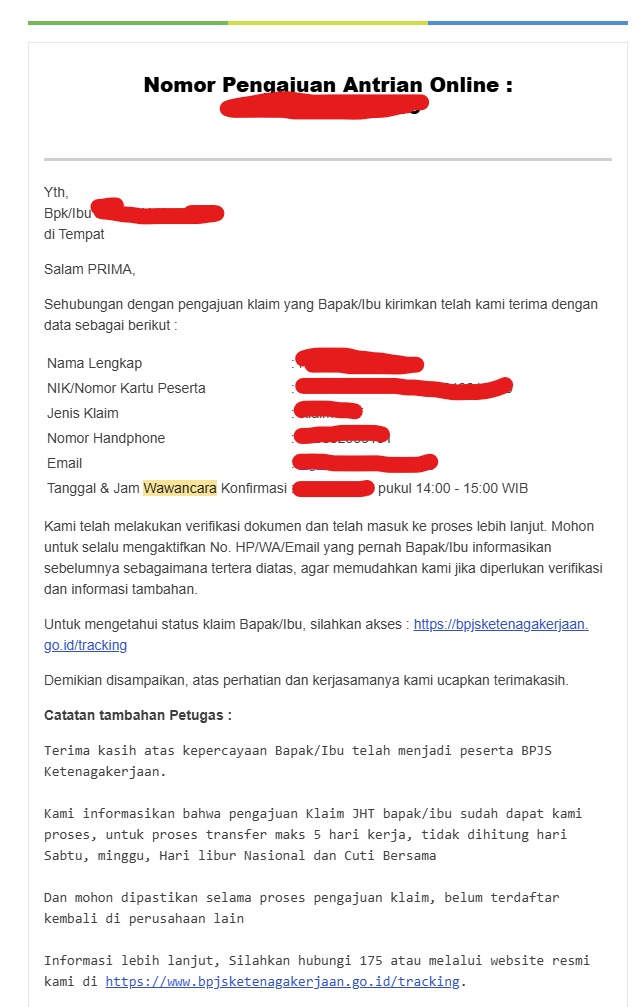
On the scheduled day, a BPJS officer will contact you via WhatsApp to verify your data and documents. Ensure you have the original physical documents ready.
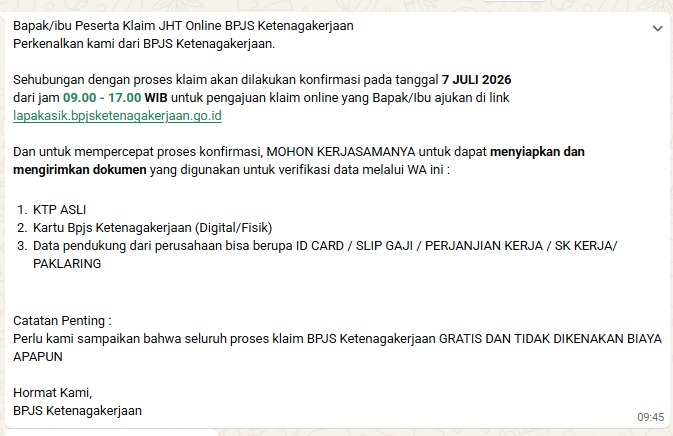
You can track the overall progress of your claim through the official BPJS Ketenagakerjaan Tracking Portal.
#2. Don't Skip Unemployment Benefits
This is something I think many people overlook after a layoff.
Unemployment benefits are not severance pay. They're a separate program.
If you qualify, unemployment benefits can serve as a temporary safety net while you search for your next role.
Benefits typically include:
- Cash assistance for a limited period
- Job market information and placement services
- Skills training or retraining programs
Eligibility usually requires a minimum contribution period before the layoff. Applications are typically filed online through your government's labor or employment agency portal (such as SIAPkerja in Indonesia).
Don't wait too long. In most jurisdictions, there's a deadline for filing — often within 2-3 months of your last working day. Benefits may be available for up to 6 months, subject to ongoing requirements.
So after being laid off, don't just ask:
"How much severance am I getting?"
Also check:
"Do I qualify for unemployment benefits?"
These are two different things.
#3. Make Sure Your Health Insurance Stays Active
Don't overlook this one. After a layoff, confirm the status of your health coverage immediately.
Depending on your jurisdiction, you may have specific protections. For example, in some systems (like Indonesia's BPJS Kesehatan), laid-off workers can continue using their health insurance for up to 6 months for free, provided their former employer has properly reported the termination. Other countries have systems like COBRA, which allow you to keep your plan by paying the premium yourself.
However, never assume your coverage is automatically active. What you can do:
- Check your insurance status through your provider's app or portal.
- Verify that family members on your plan are also still covered.
- If your status shows as inactive, contact your provider or your former employer's HR to ensure the layoff was properly reported.
Better to check now than to find out your coverage lapsed when you actually need it.
#4. Get Your Employment Certificate Before Company Access Is Cut
This seems simple, but I think it's important enough to call out.
Request your employment certificate or reference letter before your company access is fully revoked.
After your last day, you'll typically lose access to:
- Company email
- HR portals
- Internal systems
- Work documents
And after that, getting documents you forgot to save becomes much harder.
An employment certificate is useful for:
- Applying to new positions
- Verifying work experience
- Proving your tenure at the company
- Various administrative purposes
Make sure the information is accurate, especially:
- Your full name
- Company name
- Job title
- Employment period
- Last working date
Beyond the employment certificate, I also recommend saving copies of:
- Your termination or layoff letter
- Employment contract or agreement
- Last pay stubs
- Severance or compensation documents
- Benefits enrollment records
- Any other documents you might need in the future
If possible, save everything to your personal email or cloud storage.
Don't rely solely on your company email.
#Don't Panic and Apply to 100 Companies
Getting laid off makes you want to move fast.
Update LinkedIn. Update your resume. Reach out to recruiters. Start applying.
All of that matters.
But I'd recommend taking a little time to make sure the administrative side is handled first.
Simple checklist:
- Check and claim your retirement or severance fund
- Check if you qualify for unemployment benefits
- File for unemployment benefits if eligible
- Verify your health insurance status for you and your family
- Request your employment certificate
- Save your layoff letter, contract, pay stubs, and compensation documents
- Make sure all important documents are stored in your personal accounts
A layoff ends one job.
But the first few days and weeks after are also critical for making sure none of your rights or documents fall through the cracks.
Handle the important stuff first.
Then focus on what's next: finding a new job and getting back on your feet.
#Related References (Indonesian Guidelines)
- BPJS Kesehatan: 6-Month Free Coverage for Layoff Victims
- Government Optimizes Worker Protection via JKP & JKK
- Government Regulation (PP) No 6 Year 2025 on JKP
Note: Employment benefit regulations, unemployment insurance, and health coverage continuation rules vary by country and individual circumstances. Always check the latest information from your local employment and insurance agencies before filing claims.