EN · FISHKEEPING
Your Water Change Just Spiked Ammonia: The Chloramine Trap
Ammonia reads higher right after a water change, and the usual response makes it worse. The culprit is often chloramine in tap water: the conditioner breaks it, the ammonia stays behind as ammonium, and a total-ammonia test cannot tell the difference.
Published: October 26, 2026
Updated: October 26, 2026
4 min read
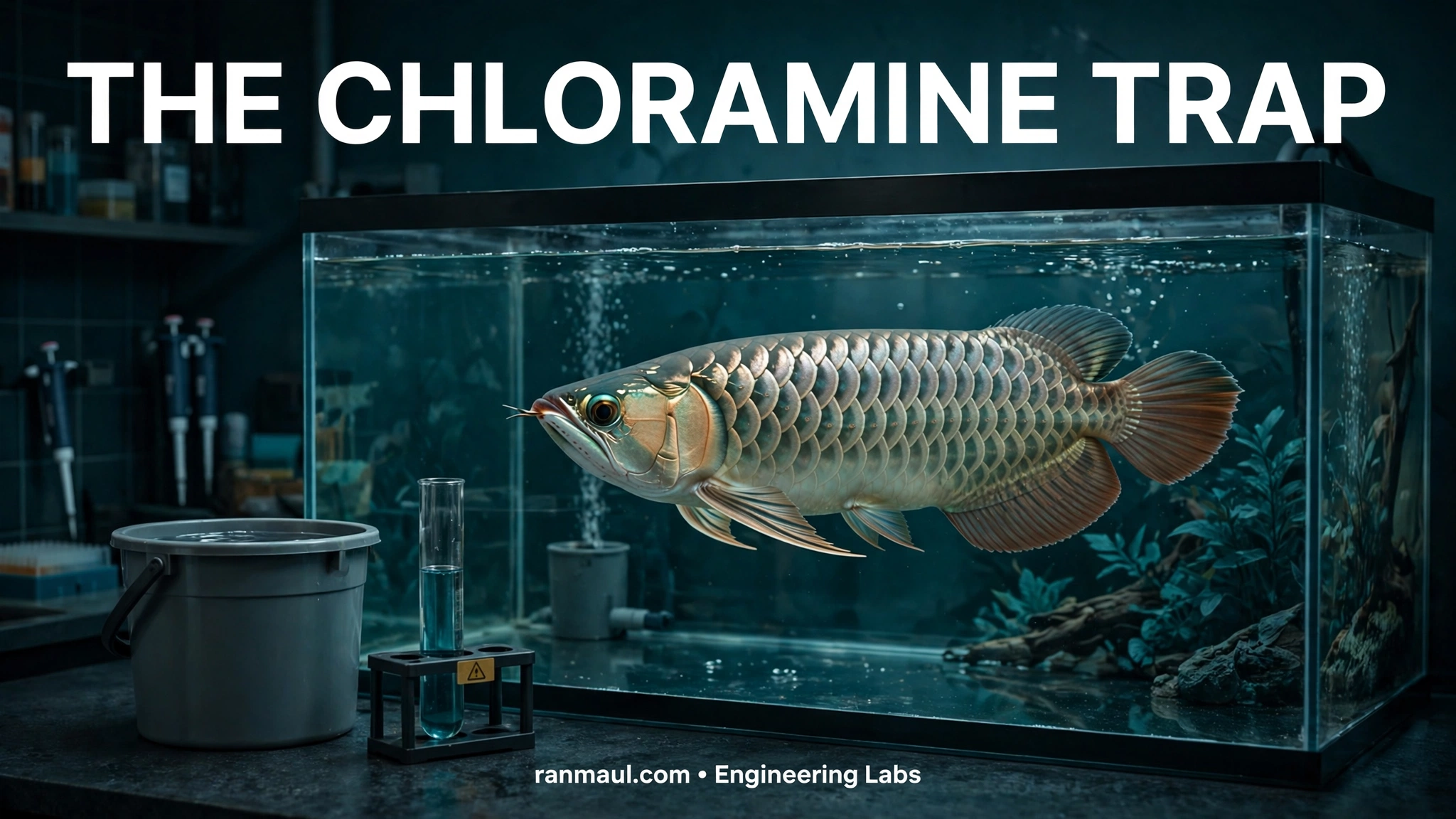
You did the responsible thing. The tank looked off, so you changed the water. Then you tested, and the ammonia reading went up.
The instinct that follows is the trap: change more water, faster. If the cause is chloramine in your tap water, every extra change pours in more of the very thing you are trying to remove, and the test keeps punishing you for it.
#What chloramine actually is
Many municipal water supplies disinfect with chlorine or chloramine. Chloramine is chlorine bonded to ammonia. It stays active in pipes longer than chlorine alone, which is why utilities use it.
That bond matters at your bucket. A standard dechlorinator removes chlorine. A conditioner that explicitly treats chloramine goes one step further: it breaks the bond, neutralizes the chlorine portion, and leaves the ammonia portion behind, mostly in the form of ammonium (NH4+).
Ammonium is far less toxic than free ammonia (NH3). Your biofilter will process it in time. But your test kit cannot see that distinction, and that is where the panic starts.
#Why the test scares you
Most hobby kits measure total ammonia: NH3 plus NH4+ together. After a water change with chloramine-treated tap water, total ammonia reads higher even when the dangerous free ammonia is under control.
Two more facts decide how dangerous a reading is. Higher pH and higher temperature push more ammonia into the toxic NH3 form, so the same number is more dangerous at pH 8.0 than at pH 6.8. And in an established, cycled tank, the goal is 0 ppm ammonia and 0 ppm nitrite at all times.
So the number alone is not the diagnosis. The number plus pH, temperature, and what the fish are doing is.
#The trap, step by step
It usually plays out like this. You change water with tap water that contains chloramine. Your conditioner breaks the chloramine and leaves ammonium behind. The test shows total ammonia, and the number climbs. You conclude the filter crashed. You change another large volume, which adds more chloramine, which adds more ammonium, which the test reads again. Meanwhile the fish, already stressed, absorb the temperature swings and the disruption of every change.
None of this means your filter is dead. It means you are reading the wrong number and reacting to it with the one tool that feeds the cycle.
#Test the tap before you panic
Before the next change, test the tap water itself. Dose a bucket of tap water with your conditioner, wait a few minutes, and test that bucket. If it reads ammonia, your tap water is contributing it, and the tank reading after a change is at least partly imported.
Then test the tank for free ammonia specifically, not just total ammonia. A free-ammonia test or an ammonia alert badge reads NH3 only. That is the form that burns gills. If free ammonia is near zero and the fish are behaving normally, you are looking at a false alarm, not a crash.
This one check separates two completely different situations, and it costs one test.
#False alarm versus real emergency
Do not let this article talk you out of acting when action is real. If fish are gasping at the surface, clamping fins, or acting drunk, treat it as an emergency regardless of what caused it. Increase surface agitation and oxygen first, stop feeding for 24 to 48 hours, and do a large change with dechlorinated, temperature-matched water. Dose a detoxifier for the full tank volume exactly as its label directs, and retest in one to two hours.
Detoxifiers are temporary protection, not a fix. They buy the biofilter time to catch up. They do not replace water changes, and they do not excuse a dead filter.
The difference is the trigger. A real emergency is diagnosed from fish behavior plus free ammonia. A false alarm is diagnosed from a total-ammonia number alone, right after a change, in a tank where the fish look fine.
#The safe water-change protocol
- Use a conditioner that explicitly treats chloramine, not just chlorine. Dose for the full volume you are changing, as the label directs.
- Test the conditioned tap water once, so you know your baseline. If it reads ammonia, expect the tank test to read it too.
- Match temperature closely. Stability beats perfection, but a big swing is its own shock.
- Change a steady portion on a schedule instead of large emergency volumes when nothing is actually wrong.
- Never rinse filter media under tap water, and never replace all media at once. That is how a false alarm becomes a real crash: you strip the bacteria while chasing a number.
- Judge by free ammonia and fish behavior, and retest morning and evening until ammonia and nitrite are consistently zero.
#Conclusion
A water change that spikes ammonia is not proof your tank failed. It is often proof your tap water carries chloramine and your test kit reads total ammonia. Test the tap, check free ammonia, and let the fish tell you whether it is an emergency. The calm response is also the correct one: condition properly, change steadily, and stop feeding the trap with more water.