EN · FISHKEEPING
True Blue or Not? Telling Channa pardalis Apart from Channa sp. 'Meghalaya'
Two blue snakeheads, two labels, one recurring rumour. The two famous ID traits for Channa pardalis and Channa sp. 'Meghalaya' break down on real fish — here is what to check before you pay.
Published: October 21, 2026
Updated: October 21, 2026
5 min read
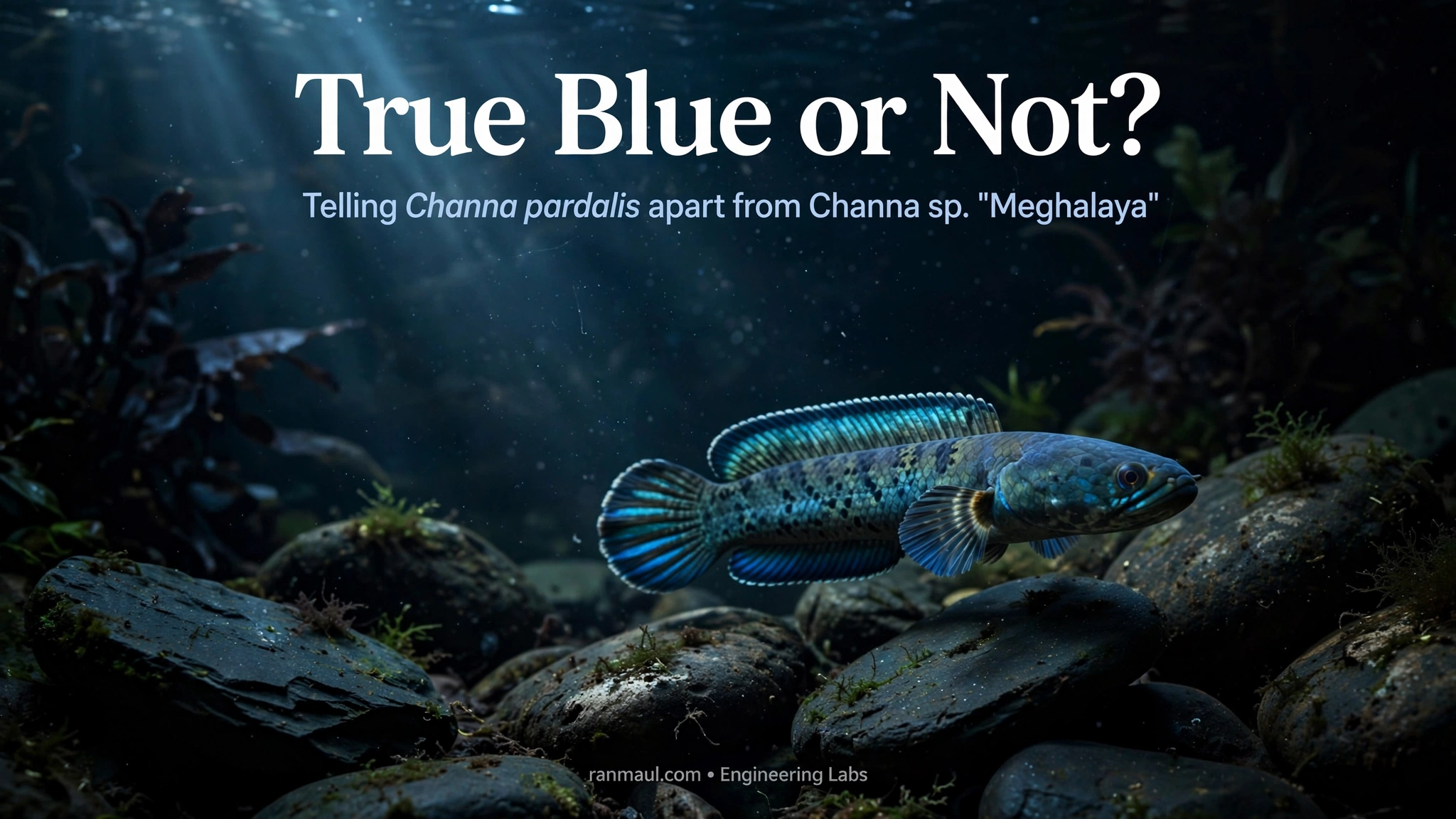
Two tanks, two blue snakeheads, two different labels. One says Channa pardalis, the famous "True Blue". The other says Channa sp. "Meghalaya". The price tags rarely match, and the seller's explanation usually starts with two traits: look at the face, look for the orange patch.
Before you pay for either label, you should know how that story ends. The most careful side-by-side check of these fish reached an awkward conclusion: the famous traits do not hold up.
#Why are there two names for what looks like one fish?
The short history explains the confusion. Blue snakeheads from the Khasi Hills in Meghalaya, northeastern India, circulated in the hobby for years under trade names. Two of those names were Channa sp. "True Blue" and Channa sp. "Meghalaya".
In 2016, J.D. Marcus Knight formally described the fish as Channa pardalis. The description was based on the Khasi Hills population, the same fish the trade had been selling as "True Blue".
That should have settled the naming. It did not. A rumour persisted in the hobby: the fish traded as sp. "Meghalaya" is not pardalis at all, but a second, still undescribed species. Wholesalers kept listing both names, and shops kept receiving both labels.
#What are the two famous differences?
The rumour comes with a neat identification key. Compared with C. pardalis, the sp. "Meghalaya" is said to differ in exactly two ways:
- No black spots on the face. A true pardalis carries bold black spots behind the eye and across the gill cover. The "Meghalaya" supposedly lacks them.
- A bright orange zone in front of the eye. The "Meghalaya" supposedly shows it. The pardalis supposedly does not.
Two traits, both visible in a shop tank, both easy to repeat. That is exactly why the story spread. It is also why it deserved a proper test.
#What happened when someone checked real fish?
Aquarium Glaser, the German wholesaler, had both fish in stock at the same time. Frank Schäfer photographed the largest pair of sp. "Meghalaya" (14–15 cm) next to the smallest juvenile and compared them against the two famous traits.
The results were mixed in the worst possible way:
- The female matched the rumour perfectly. No black spots on the face, and a bright orange zone in front of the eye.
- The male broke half the key. He also lacked black face spots, but showed no trace of an orange zone at all.
- The juvenile broke the other half. Its face was covered in black spots, so it looked like a pardalis that had wandered into the wrong tank. Then the orange zone in front of its eye gave it away as "Meghalaya".
His conclusion is worth quoting in spirit: there are no constant differences in head colouration between Channa pardalis and Channa sp. "Meghalaya". Keep them separate, breed them separate, but do not claim a clean visual split.
#What does the formal description of pardalis actually say?
Knight's 2016 description gives C. pardalis a precise diagnosis. The usable parts for a keeper are these:
- Numerous large black spots on the post-orbital region of the head, the opercle (gill cover), and the body.
- A broad black-and-white margin on the dorsal, anal, and caudal fins.
- A blue-grey body in life, with a bright blue head and gill cover.
The rest of the diagnosis is meristic: 36–37 dorsal fin rays, 24–25 anal fin rays, 44–45 pored lateral-line scales, 45 vertebrae. Accurate, and completely useless across a shop counter. Nobody counts fin rays on a stressed fish in a bag.
Notice the tension. The formal description makes black head spots a defining feature of pardalis. The trade rumour makes their absence the mark of "Meghalaya". Glaser's photos show individual fish ignoring both scripts.
#So how do you buy one without getting burned?
You cannot key these fish out like a bird in a field guide. You can still stack the odds in your favour:
- Judge the whole pattern, not one trait. Spots, fin margins, and body colour together say more than any single mark.
- Ask for the source, not just the name. Which wholesaler, which stock code, which shipment. Glaser lists the two under separate codes (409383 for pardalis, 409283 for sp. "Meghalaya"). A seller who knows the chain is a better bet than one repeating a label.
- Compare adults, not juveniles. Colour and spotting shift as these fish grow. A 6 cm juvenile is the hardest possible specimen to judge.
- Photograph the fish before it is bagged. You want the head from the side, in good light. That photo is your evidence if the fish colours up differently at home.
- Do not pay a species premium for a rumour. If the price gap rests only on the two famous traits, the gap rests on sand.
- Keep the two labels separate at home. Whatever the truth of the rumour, mixing them destroys the very information that could settle it. If "Meghalaya" is a distinct species, crossing it with pardalis helps nobody.
- Buy the fish, not the story. A healthy, well-patterned blue snakehead is a great fish under either label. Pay for condition and pattern quality first.
#The bottom line
Channa pardalis is a described species with a real diagnosis. Channa sp. "Meghalaya" is a trade label carrying an unproven rumour. The two head-colour traits that supposedly separate them collapse as soon as someone checks a male, a female, and a juvenile side by side.
So the honest answer to "true blue or not?" is this: nobody can tell you from across the tank. Buy from a traceable source, judge the whole fish, keep the labels separate, and never let two unreliable traits set the price.
#References
- Knight, J.D.M. (2016). Channa pardalis, a new species of snakehead (Teleostei: Channidae) from Meghalaya, northeastern India. Journal of Threatened Taxa 8(3): 8583–8589.
- Schäfer, F. (2017). Channa sp. Meghalaya. Aquarium Glaser.