EN · FPV
O4 Pro Stabilization Jitter Under Low-Frequency Vibration: Field Notes
Observed stabilization inconsistency on newer O4 Pro units, with a cautious breakdown of what is measured, what is inferred, and what remains unknown.
Published: May 12, 2026
Updated: May 12, 2026
2 min read
#Context / Problem
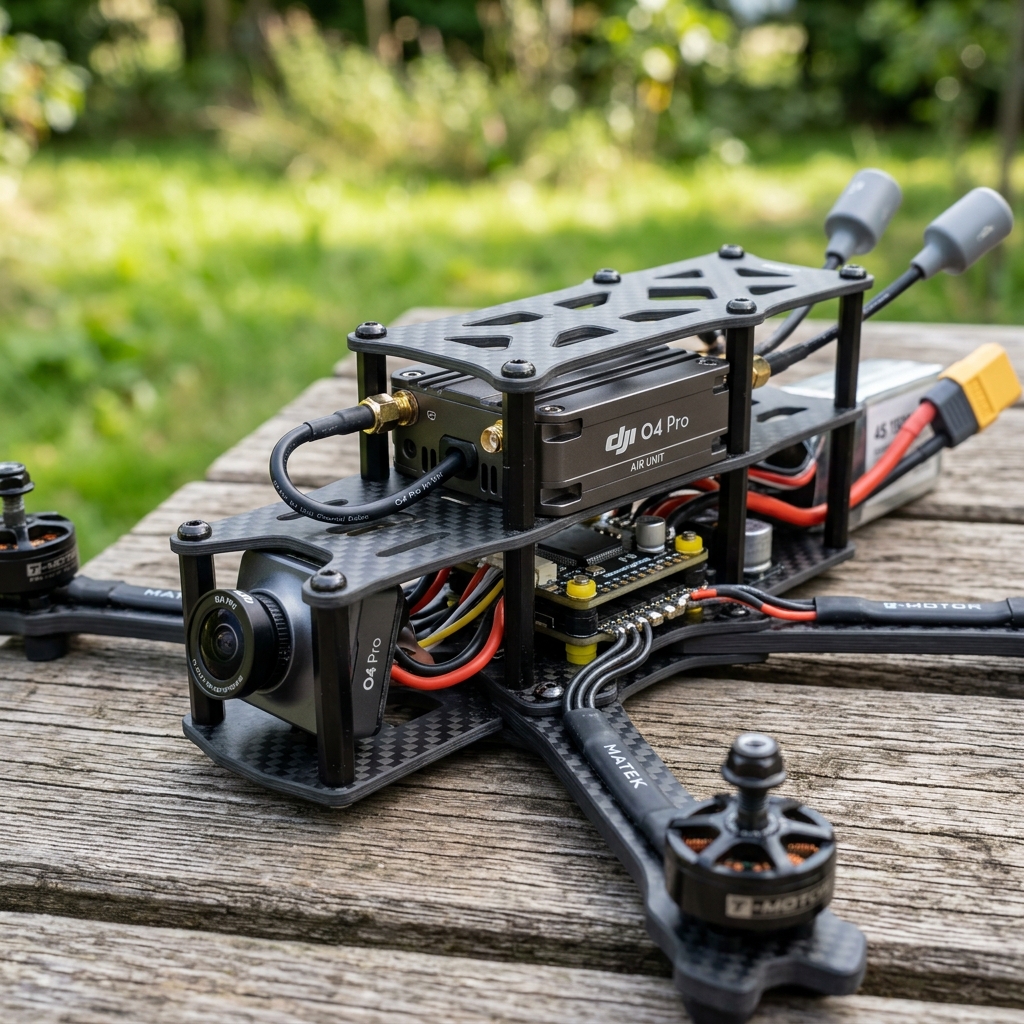
During routine cinematic flights, I started seeing intermittent micro-jitter in stabilized output from a newer O4 Pro setup. The artifact appeared as brief frame-level twitching that was not consistently visible in live feed, but became obvious during replay and speed-ramped sequences.
#Constraints
- I had no controlled lab rig for repeatable motor vibration injection.
- Wind and terrain were variable across sessions.
- Aircraft stack had to remain flyable for client-adjacent field work.
- Firmware rollback options were limited for direct A/B isolation.
#Investigation
I separated troubleshooting into measurable buckets:
- Mechanical baseline: checked prop balance, motor bell play, arm resonance, and stack screw torque.
- Mount isolation: tested alternate damping hardness and camera mount tension.
- Filter profile: compared conservative and aggressive low-pass settings while logging blackbox vibration bands.
- Flight condition split: repeated passes under smooth cruise, throttle punch, and yaw-heavy transitions.
# Example analysis sequence used after each flight set
blackbox-export --session 2026-05-12-a --channels gyro,debug,throttle
python analyze_vibe_bands.py --input session-a.csv --band-low 40 --band-high 120#Findings
#Confirmed observations
- Jitter frequency increased during throttle transients rather than steady cruise.
- The artifact correlated with elevated energy in lower gyro bands (roughly 55–95 Hz in repeated sessions).
- Harder mounting reduced large wobble but sometimes made micro-jitter more visible.
#Plausible but unconfirmed
- Newer hardware revision tolerance may be less forgiving to low-frequency frame vibration.
- Some stabilization behavior might be more sensitive to specific vibration signatures than earlier units.
I cannot claim a definitive hardware defect from current data. The evidence supports sensitivity differences, not root-cause certainty.
#Trade-offs
- Softer isolation improved micro-jitter in some flights, but introduced slight horizon lag in rapid directional changes.
- Heavier filtering reduced visible jitter but cost some control sharpness and post-processing flexibility.
- Conservative tune is safer for delivery consistency, but less agile for freestyle-style movement.
#Final Takeaways
- Treat the issue as a vibration sensitivity problem first, hardware defect second.
- Use repeatable flight profiles when diagnosing stabilization behavior; random freestyle data is hard to compare.
- Keep claims bounded by evidence: separate measured correlation from speculation.
- A practical mitigation stack today is: strict mechanical baseline + moderate damping + conservative filter profile + scenario-specific flight style adjustments.