EN · FPV
DJI O4 Wide vs O4 Pro vs O4 Lite: Which Air Unit to Buy
DJI now sells three O4 air units, and the Wide changed the answer for micro builds. Compare sensor, weight, FOV, gyro, and price, then pick by frame size.
Published: November 12, 2026
Updated: November 12, 2026
7 min read
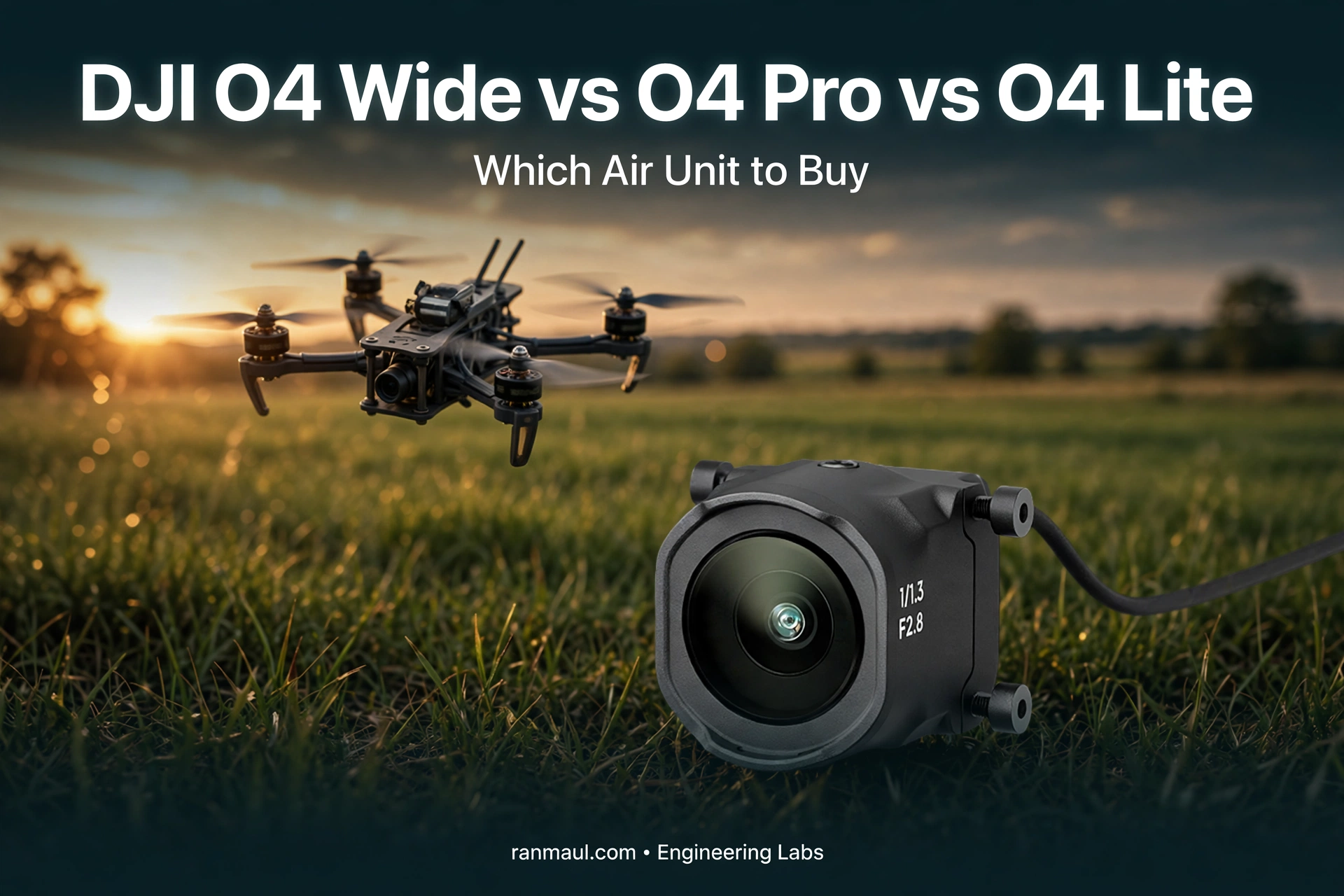
DJI's O4 line is now three products, not two. The O4 Wide arrived with a built-in wide-angle lens, and it changed the default answer for micro builds. The original O4 Lite has reportedly stopped production. If you are buying an air unit today, the choice is Wide, Pro, or leftover Lite stock.
The wrong pick costs you twice. A Pro on a 2-inch whoop is 32 grams of dead weight. A Lite on a 5-inch freestyle rig is a narrow, flat image you will regret every flight. This article compares the three units on the numbers that decide the pick, then gives you the decision by frame size.
#The three units at a glance
| O4 Lite | O4 Wide | O4 Pro | |
|---|---|---|---|
| Sensor | 1/2-inch | 1/2-inch | 1/1.3-inch |
| Recording | 4K/60fps | 4K/60fps | 4K/120fps, D-Log M, 130 Mbps |
| Field of view | Narrow | 159° | Standard, Wide, Ultra Wide |
| Weight (with camera) | 8.2 g | ~13.6 g | 32 g |
| Gyro | 1469D (ICM-40609-D) | 1469D (ICM-40609-D) | MP66 (MPU-6050) |
| Race Mode latency | ~20 ms | ~20 ms | 15 ms |
| Max range (FCC) | Shorter than Pro | Shorter than Pro | 15 km |
| Launch price | About a third of the Pro | Check current listings | $229 |
Weights are DJI's figures, except the Wide: Oscar Liang measured 13.6 g for camera, VTX, and antenna together. DJI lists 13.3 g. Either way, the Wide costs you about 5 grams over the Lite.
#What the Wide changes, and what it does not
The Wide is the same O4 Lite hardware with a built-in wide-angle lens. Same 1/2-inch sensor, same gyro, same VTX. The only difference is the lens and the housing around it.
That one change fixes the Lite's biggest complaint. The original O4's narrow field of view made proximity flying feel cramped. The Wide opens it to 159°, and Oscar Liang's side-by-side test found its image slightly wider than the Flywoo aftermarket wide-angle lens, with a touch more fisheye at the edges. Sharpness and detail are effectively the same. Color runs a little greener than the Lite; white balance fixes that in post.
The housing changed too, and that has practical costs. The camera is 14 mm wide with mounting holes 16 mm apart, like the Lite, but it now uses M2 screws and needs a new canopy design. The cable is about 5 cm long. Old ND filters do not fit. Flywoo's ND filters for the new housing fit loosely and can fall out in a crash, so expect to wait for filters made for this camera.
#The gyro problem the Wide kept
Here is the disappointment: the Wide still uses the 1469D gyro. That is the same vibration-sensitive gyro behind the O4 Pro's stabilization trouble, and DJI did not swap it.
The 1469D (ICM-40609-D) mistakes motor vibration for rotation more easily than the MP66 in the Pro. The result is jello or jitter in stabilized footage on frames that vibrate. This site covered that failure mode in depth: the O4 Pro gyro software fix, the low-frequency vibration jitter, and the gyro-swap footage recovery. The same checks apply to the Wide.
There is a workaround if stabilization matters to you. Flywoo sells a custom O4 Wide with the MP66 gyro (MPU-6050), the same gyro the Pro uses. It costs more than the official unit, and it ships with adapters and ND filters. Oscar Liang's own Gyroflow test of the stock Wide came back clean on a BetaFPV Meteor75 Pro II and a Flywoo Firefly18, with no jitter at all. So the gyro is a risk, not a certainty. Check your mount first: too much or too little soft mounting causes more stabilization trouble than the gyro does.
#When the Pro is still worth the weight
The Pro is a different class of camera. Its 1/1.3-inch sensor is much larger than the 1/2-inch sensor in the other two, and it shows in low light and color depth. It records 4K at up to 120 fps with 10-bit D-Log M at 130 Mbps. That is footage you can grade like an action camera.
It also wins on the link. Race Mode latency is 15 ms against about 20 ms for the Lite and Wide. Max range is 15 km under FCC rules (8 km under CE). Two antennas help it hold the link further out.
The price is weight and money: 32 grams and $229 at launch. It needs a 3-inch frame or larger, on 2S to 6S. Buy the Pro when the footage is the product: cinematic flying, long range, or any build where you grade the video afterwards. For anything else, the weight is hard to justify.
#When the Lite still wins
The Lite's only real advantage is weight: 8.2 grams. On a 1S tiny whoop, 5 grams is the difference between flying well and flying like a brick. The Wide's extra 5 grams can be a real problem on the smallest builds, and Oscar Liang says so directly.
The Lite also takes the standard canopy and filter ecosystem that already exists. But the original O4 has reportedly stopped production. Once current stock runs out, the Wide is the only 1/2-inch option. Buy a Lite now only if you fly a tiny whoop and you can still find one at a sane price.
#Pick by frame size
- 1S tiny whoop (65–75 mm): Lite, if you can find one. The Wide's 5 extra grams hurt here. If no Lite is in stock, the Wide still flies, but expect a heavier feel.
- 2-inch micro and cinewhoop: Wide. The 159° view matters most in tight indoor and proximity flying, and 13.6 grams is affordable on these frames.
- 3-inch and up, freestyle or long range: Pro. The sensor, 4K/120, D-Log M, and 15 km range are what these frames are for.
- Stabilized footage is the priority: Pro, or the Flywoo MP66-gyro Wide. Do not buy the stock Wide and hope the gyro behaves on a vibrating frame.
- Budget build on a 2–3-inch frame: Wide. It replaces the Pro in many builds where you do not need the best image quality, for much less money and half the weight.
One availability note: the Wide is reportedly not sold in the United States or Puerto Rico, per DroneXL's report. If you are in the US, check your retailer before you plan a build around it.
#Before you order
- Measure the canopy. The Wide needs a canopy made for its larger lens housing. Your Lite canopy will not fit.
- Order ND filters made for the Wide. Old filters do not fit, and the first third-party ones fit loosely.
- Check the gyro on your frame. If your frame vibrates, budget for the MP66 version or plan a soft-mount fix. Do not discover the jello after the build.
- Confirm the goggles. All three units use the same DJI O4 link, so your existing DJI goggles carry over. The decision is about the camera, not the goggles.
- Check stock, not just price. The Lite is end-of-line, and the Wide's availability varies by region. A unit you cannot buy is not a bargain.
The O4 line finally has a sensible middle. The Lite was too narrow, the Pro was too heavy, and the Wide sits between them for most micro builds. Buy the Pro for the footage, the Lite for the grams, and the Wide for everything in between.
#References
- Oscar Liang: DJI O4 Wide Air Unit review
- Oscar Liang: DJI O4 Air Unit Pro review
- DroneTrader: DJI O4 Air Unit explained: Pro vs Standard vs Wide
- Ranmaul.com: O4 Pro gyro software fix before hardware swap
- Ranmaul.com: O4 Pro stabilization jitter under low-frequency vibration
- Ranmaul.com: Recovering O4 Pro footage: 2026 gyro swap