EN · FISHKEEPING
When the Power Goes Out: Air First, Heat Second, and the Safe Restart for Predator Tanks
Oxygen runs out in hours; temperature falls over a much longer timescale. The outage plan for a large sump-filtered predator tank: one battery air pump, no feeding, and a restart that does not undo the survival.
Published: November 3, 2026
Updated: November 3, 2026
8 min read
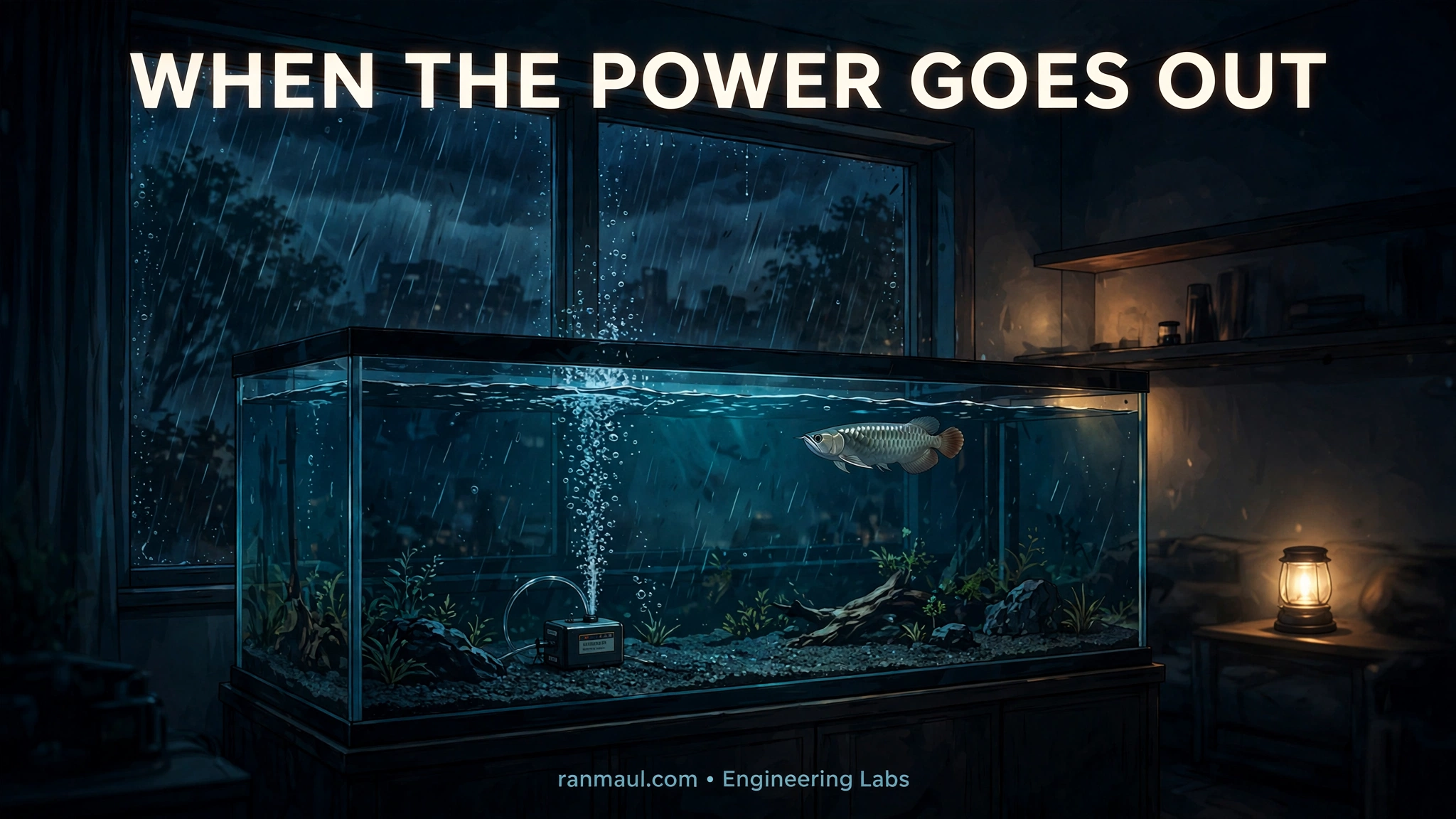
The rain is hammering the roof, the lights go out, and the room falls silent. The first thing you notice is the filter. No hum from the return pump, no ripple on the surface. The tank looks peaceful. It is not. The clock has started, and the first thing it runs out is not heat. It is oxygen.
Most power-cut advice starts with blankets and heaters. That is the wrong end of the problem. When the electricity goes, your filter stops, the surface goes still, and the tank stops exchanging gas with the room. The fish keep breathing, the bacteria in your filter media keep breathing, and at night the plants do too. Consumption carries on. Resupply stops.
This article covers the unplanned event. The site has already published the planned-maintenance pieces: cleaning a sump one chamber at a time, recovering the cycle after a media reset, and testing tap water that changes in rainy season. Those are jobs you schedule. A blackout is a job that schedules you.
#What actually kills first
Water holds surprisingly little oxygen, and warm water holds less. Fully saturated fresh water carries roughly 9 mg per litre at 20 °C, about 8 mg at 25 °C, and about 7.5 mg at 30 °C. A warm, heavily stocked predator tank starts from the worst possible position: the highest demand and the lowest ceiling.
A warm, heavily stocked tank with no surface movement can show distress within two to four hours. Stocking level and temperature drive the timeline far more than tank size does. A lightly stocked, cooler tank in daylight may be fine for most of a day. Your 300-litre predator tank is not that tank. Big fish breathe a lot, and a sump full of bio media breathes with them.
Temperature works on a completely different clock. A 200-litre tank in a 15 °C room loses roughly one degree every two to three hours, slower still with a lid and a blanket over it. A lidded, blanketed tank of that size in a 14 °C room will often hold above 22 °C for most of a day. In a Jakarta rainy season, the room is rarely that cold. The cold problem arrives later, if it arrives at all. The oxygen problem arrives first. That is exactly the opposite of the order most people act in.
One more thing buys your arowana time but not your tank: arowanas are facultative air breathers. They can gulp air at the surface into a swim bladder lined with capillaries, like lung tissue. An arowana calmly piping at the surface may look fine while the gar, the belida, and the nitrifying bacteria are running out of dissolved oxygen. Do not read one fish's calm as the tank's all-clear.
#The first ten minutes, the first four hours, overnight
First ten minutes: get air moving. Battery pump on, or start manual agitation. Put the lid on and leave the lights off. Note the time; you will want it later. Do not open the filter, do not feed, do not change water in the dark.
First four hours: insulate. Lid on, a folded blanket over and around the tank, curtains closed. Leave a small gap for the airline. Check the thermometer every hour and write the numbers down. The rate of fall tells you whether heat is going to become a real problem. Keep the tank dark; fish are calmer and use less oxygen.
Overnight and beyond: keep the air going. In darkness, plants consume oxygen instead of producing it, so a planted tank's overnight demand is higher than its daytime demand. If the temperature has dropped several degrees, accept it and keep it stable rather than trying to correct it without power. A steady 20 °C is much kinder than a sawtooth between 18 and 24.
Do not pour hot water straight into the tank. It scalds fish and shocks everything else. If you must add heat, seal hot water in a bottle or a zip bag and float it. Do not feed at all until filtration is back and running. Uneaten food with no filtration turns into an ammonia problem on top of an oxygen problem. A day without food does a healthy fish no harm at all.
#The one item worth buying
A battery or USB air pump with an air stone, airline, and a check valve. It is cheap, it is small, and it is the difference between a nervous night and a dead tank.
The numbers explain why it wins over every other backup. A typical USB nano pump uses 1–2 W, so a 10,000 mAh power bank, roughly 30 usable watt-hours after conversion losses, will run one for somewhere between fifteen and thirty hours. A heater draws 100–300 W, which flattens a typical UPS or power bank in minutes to an hour. If you have one battery, it belongs on the air pump. A small UPS will run an air pump for many hours for the same reason. It will not meaningfully run a heater.
The bubbles themselves transfer relatively little oxygen. The value is the surface disturbance they create as they break, which is where the actual gas exchange happens. That is also why the manual fallback works: scoop a jug of tank water and pour it back from a height, for thirty seconds every half hour. It genuinely works, because it breaks the surface.
Fit the check valve in the airline, above the water line, the right way round. When a pump below the tank's water level stops, water siphons back down the airline, through the pump, onto the floor, and out of the tank. A small part prevents an expensive night.
Keep the rest of the kit in one labelled bin near the tank. It holds spare batteries or a charged power bank, kept charged, plus a battery headlamp and a thermometer that does not need power. Add dechlorinator, a liquid test kit for ammonia and nitrite, blankets or foam board, and a clean jug that has never seen soap. Check batteries and expiry dates twice a year. A kit you have to assemble in the dark is not a kit.
#The safe restart
Power returns. This is where tanks are lost a second time.
First, check the heater is fully submerged before it energises. If evaporation or a spill has left it partly exposed, unplug it at the wall first. This is when heaters crack. The same check applies to a heater sitting in the sump: water level in the sump drops when the return pump stops and the display drains down, so verify it before anything powers up.
Second, restart the filter carefully. A sump is open to the air, so it does not go anoxic the way a sealed canister does. Still, water that has sat still for hours in the sump chambers, full of detritus, is not water you want blasted into the display in one go. Restart the return pump and watch the first minutes: cloudy water or a sulphurous smell means the sump needs attention before normal flow resumes. The sealed-filter warning is stricter: a canister that has stood still for more than a couple of hours has media that has gone anoxic, and switching it on pushes stagnant water into the tank. Disconnect it, tip the old water away, rinse the media in tank water or dechlorinated water, reassemble, and then restart.
Third, let the temperature come back slowly. Do not reach for a bigger heater to catch up. Around 0.5 °C per hour is the pace. A slow drift down to 20–21 °C is tolerated considerably better than suffocation or a thermal whiplash.
Fourth, test ammonia and nitrite before you feed anything, then daily for about a week. Nitrifying bacteria are aerobic, and a long outage will usually knock the cycle back to some degree. Media that stays wet holds enough oxygen for several hours, but beyond roughly twelve hours expect a partial setback, showing up as a small ammonia or nitrite reading a day or two after power returns. If ammonia shows, treat it as new tank syndrome: small water changes and light feeding. Test rather than assume, and feed lightly until readings are clean. The most common post-outage killer is not the outage itself. It is an ammonia spike from a knocked-back filter two days later.
#The checklist
Before the next storm:
- Battery or USB air pump, air stone, airline, check valve: tested, in the bin, power bank charged.
- Thermometer that reads without power, liquid ammonia/nitrite kit, dechlorinator, clean jug, blankets.
- Know your sump: where the water level sits when the pump stops, where the heater sits, which chamber holds the detritus.
During the outage:
- Air moving within ten minutes. Lid on, lights off, no feeding, no water change in the dark.
- Insulate after air is sorted, not instead of it. Log the temperature hourly.
- Jug-pour thirty seconds every half hour if there is no pump.
After power returns:
- Heater submerged check, sump watch on restart, temperature back at 0.5 °C per hour.
- Ammonia and nitrite tested before feeding, then daily for a week. Light feeding until readings are clean.
#Conclusion
A blackout tests the same things good fishkeeping always tests: whether you prepared before you needed to, and whether you act in the right order under pressure. Air first. Heat second. Feed last. And when the lights come back, restart like the tank is recovering, because it is.